Unlock the Brain's Regenerative Pathway
The brain can rewire itself — we provide the signal.

Unmet Need
Opportunity to Improve Quality of Life
$890B
Health economic impact each year
Massive financial strain
$1T
Disease cost by 2034
First trillion-dollar disease
30 Yrs
Since last new treatment
Innovation stagnation in ischemic stroke
900K
Annual strokes in the US
70% addressable market
Vision & Mission
Restoring quality of life through regenerative biology
At Alevian, our vision is to restore quality of life for patients with debilitating neurological and aging-related diseases by precisely targeting biological mechanisms that promote repair and regeneration. Our mission is to develop innovative biologics that activate the body's intrinsic repair systems to reverse the damage caused by injury, chronic disease, and aging.
Approach
Targeting untapped therapeutic windows
Alevian is pioneering a new class of regenerative therapeutics designed to modulate the molecular cascades activated in the critical hours, days, and weeks following neurological and systemic injury. Unlike traditional approaches that focus solely on restoring blood flow or providing nonspecific protection, Alevian's platform targets the precise signaling events that drive tissue damage and limit recovery.
Central to this strategy is our work on the GDF11 signaling pathway and its downstream effectors, which regulate cellular stress responses, inflammatory signaling, vascular remodeling, and regenerative capacity across multiple tissues.
Platform
Built on Regenerative Science
Our programs harness GDF11, a naturally occurring growth factor in the TGF-β superfamily that orchestrates the body's repair response. ALE-001 is an engineered recombinant form of GDF11 designed to reactivate repair mechanisms when patients need them most: after injury, when the window for conventional intervention has closed.
Anti-inflammatory
Reduces harmful inflammation after injury
Neurogenic
Supports growth of new neural tissue
Angiogenic
Promotes vascular remodeling and blood flow
Stem-cell driven
Activates endogenous stem cell repair
Neuroprotective
Protects tissue from secondary damage
Multi-mechanistic
One platform, multiple high-value indications
One Platform. Multiple High-Value Indications.
ALE-001 Therapeutic Programs
Acute Ischemic Stroke
Our most advanced program targets the acute phase of stroke recovery, where no approved therapies exist. ALE-001 is progressing toward first-in-human studies.
Intracerebral Hemorrhage
Hemorrhagic stroke carries even higher mortality and disability rates than ischemic stroke. ALE-001's anti-inflammatory and vascular-repair properties address secondary injury cascades.
Chronic Ischemic Stroke
Millions of stroke survivors live with long-term disability, with no approved therapies to restore brain function months to years after injury.
Traumatic Brain Injury
With over 2 million U.S. cases annually and no disease-modifying treatments available, TBI represents a substantial opportunity.
Metabolic & Age-Related Disease
Expanding our platform into indications driven by chronic inflammation, vascular decline, and impaired tissue maintenance.
Pipeline
Development Progress
Acute Ischemic Stroke
Late Preclinical
ALE-001
Intracerebral Hemorrhage
Mid Preclinical
ALE-001
Traumatic Brain Injury
Mid Preclinical
ALE-001
Chronic Stroke
Discovery
ALE-002
Metabolic Disease
Discovery
ALE-002
Research
Publications & Poster Presentations
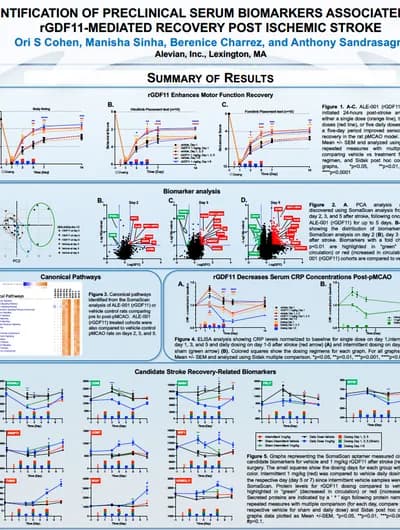
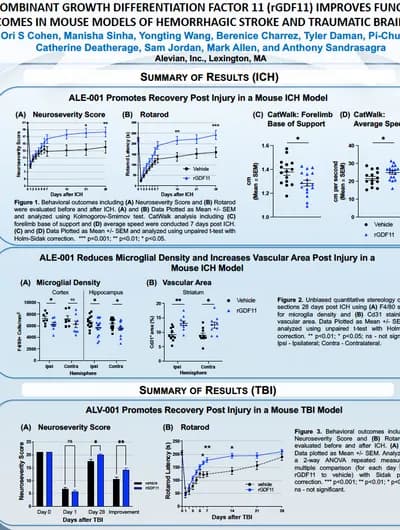
GDF11 Science
Peer-Reviewed Research
A growing body of published research demonstrates GDF11's potential to promote neuroregeneration, improve stroke recovery, and address metabolic disease.
Brain & Neurological Recovery
Identification of Novel Therapeutic Targets for Cognitive Performance and Associations with Brain Health
Zhang, Liu et al. · Translational Psychiatry, 2025
Novel Insights into the Pleiotropic Health Effects of Growth Differentiation Factor 11 Gained from Genome-Wide Association Studies in Population Biobanks
Strosahl, Ye, Pazdro · BMC Genomics, 2024
GDF11 Rejuvenates Cerebrovascular Structure and Function in an Animal Model of Alzheimer's Disease
Zhang et al. · Journal of Alzheimer's Disease, 2018
GDF11 Improves Neurobehavioral Recovery and Stimulates Angiogenesis in Rats Subjected to Cerebral Ischemia/Reperfusion
Ma et al. · Brain Research, 2018
GDF11 Promotes Neurovascular Recovery After Stroke in Mice
Xiao et al. · Frontiers in Cellular Neuroscience, 2018
Growth Differentiation Factor-11 Supplementation Improves Survival and Promotes Recovery After Ischemic Stroke in Aged Mice
Hudobenko et al. · Aging, 2020
Metabolic & Age-Related Disease
GDF11 Attenuates Development of Type 2 Diabetes via Improvement of Islet β-Cell Function and Survival
Li et al. · Diabetes, 2017
Neuroprotective Potential of GDF11 in Experimental Intracerebral Hemorrhage in Elderly Rats
Xiao et al. · Journal of Clinical Neuroscience, 2019
GDF11 Improves Angiogenic Function of EPCs in Diabetic Limb Ischemia
Zhang et al. · Diabetes, 2018
Systemic GDF11 Stimulates the Secretion of Adiponectin and Induces a Calorie Restriction-Like Phenotype in Aged Mice
Katsimpardi et al. · Aging Cell, 2019
Exogenous GDF11, but Not GDF8, Reduces Body Weight and Improves Glucose Homeostasis in Mice
Walker, RG et al. · Scientific Reports, 2020
Team
Leadership
Advisors